Notice and name
Write the condition people can actually observe. Do not pretend to have a diagnosis before the investigation has begun.
 Weirdgears
Book · Operations · Management
Plan What You Can, and Red Flag the rest.
Plans, schedules, work orders, budgets, and risk registers organize the things an organization already knows enough to organize. Operations still produces surprises: a machine changes its sound, a workaround quietly becomes normal, or a decision moves between departments without finding an owner.
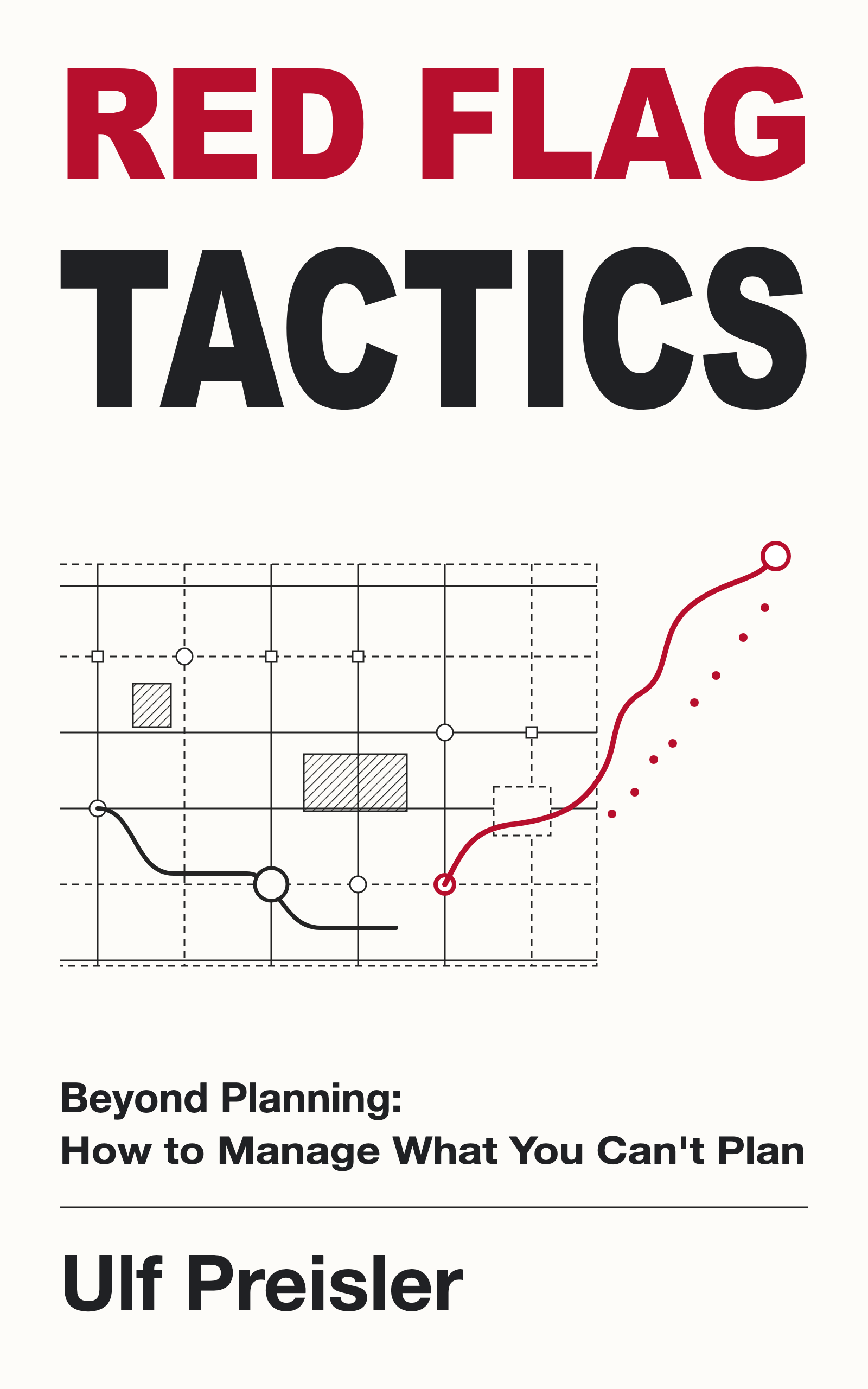
Red Flag Tactics is about the gap between somebody noticing a condition and the organization doing something about it. It gives the people closest to the work a compact way to name a credible warning, bring in the people who understand it, assign the next move, and keep the matter visible until reality changes.
The method is deliberately light: a Card, a short round, and a visible board. It does not replace planning or the operating systems that already work. It is for the point where routine control breaks down, ownership is unclear, or the people with the clearest view cannot reach the people with authority.
The operating gap
People who run operations are very good at working around things. That ability keeps work moving, but it can also hide the weak signal until the workaround spreads or the original fault becomes expensive. A Red Flag catches both the possible crisis and the drag an organization has learned to tolerate.
Seeing the problem does not create permission to solve it. The person who raises the warning, the owner of the next action, and the person with decision authority may be three different people. The Card keeps that distinction—and the trail past a refusal or blocked decision—visible.
The method
The Red Flag Game stays intentionally small. Its purpose is not to create another management system to maintain; it is to stop warnings, actions, and decisions from disappearing into inboxes and meeting notes.
Write the condition people can actually observe. Do not pretend to have a diagnosis before the investigation has begun.
Bring together a small group who know the work, group related observations, and ask direct questions at the useful level of detail.
Put a name beside the next action. If that person lacks authority, move the Card to somebody who can make the required decision.
Keep Active Cards visible. Move, escalate, close, or correct them as reality answers; do not let the board become wallpaper.
Written from practice
The book grew out of Ulf Preisler’s work across operations, technology, logistics, construction, and management—from shift supervision in a gold mine to responsibility as a CIO. The same pattern kept reappearing: operators, technicians, and supervisors saw trouble early, but the knowledge lost force on its way to someone able to act.
Red Flag Tactics turns that experience into a bounded method that can be tried with index cards and a whiteboard. No transformation program is required. The final chapter shows how to run a thirty-day trial and judge whether the method helps.
Read the book
The new edition sharpens the method, expands the practical guidance, and adds twelve new figures that make the system easier to understand and apply. It is available now for Kindle.

Amazon and the Amazon logo are trademarks of Amazon.com, Inc. or its affiliates.
Questions and field reports
If you have used Red Flag Tactics, improved it, or found an interesting new way to break it, I would like to hear from you.